
Learning piano as a beginner is much easier when you know what to do first, what to ignore for now, and what "progress" actually looks like. Most adults who quit do not quit because they lack talent. They quit because they started with the wrong material, practiced without a plan, or expected to play like a concert pianist in a month. This roadmap fixes all three.
Below you will find what you need to get started, how the keyboard is organized, your very first chords, a simple daily routine and a realistic picture of your first three months.
What you need to start
- An instrument. An acoustic piano is great, but a digital piano or keyboard works fine for a beginner. Aim for at least 61 full-size keys and touch-sensitive keys (the harder you press, the louder the note). If you can, choose 88 weighted keys, which feel closer to a real piano. Our piano vs keyboard guide explains the trade-offs.
- A sustain pedal if you use a keyboard. Many keyboards come without one, and chords sound thin without it. A basic pedal is inexpensive.
- A bench or chair at the right height. When your hands rest on the keys, your forearms should be roughly level with the keyboard, not angled up or down.
- A metronome. A free phone app is enough.
- 15 to 30 minutes a day. Short, daily practice beats a single long session on the weekend.
How the keyboard is organized
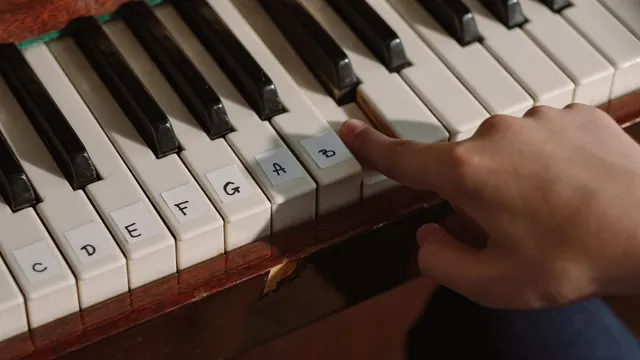
A piano keyboard looks overwhelming, but it is just one pattern of 12 keys repeated from left to right. Look at the black keys: they come in groups of two and groups of three. That pattern is your map.
- The white key just to the left of any group of two black keys is C.
- Moving right from C, the white keys are C, D, E, F, G, A, B, and then the next C begins.
- The white key just to the left of any group of three black keys is F.
- The C closest to the middle of the keyboard is called middle C. Most beginner music starts around it.
Moving left goes lower in pitch, moving right goes higher. The black keys are sharps and flats: the black key right of C is C sharp (also called D flat), and so on. You do not need the black keys much in your first weeks.
Finger numbers and hand position
Piano music uses finger numbers for both hands: thumb is 1, index is 2, middle is 3, ring is 4 and pinky is 5. Put your right thumb on middle C and let fingers 2 to 5 rest on D, E, F and G. That is "C position." Your left pinky goes on the C below middle C, with fingers 4 to 1 on D, E, F and G.
Keep your fingers gently curved, as if you were holding a small ball. Play with the pad of each finger, not the flat finger. Keep your wrists level and loose. Tension is the number one physical problem for adult beginners, so check your shoulders every few minutes and let them drop.
Step 1: Play a five-finger warm-up
In C position, play C-D-E-F-G and back down with your right hand, one finger per key, slowly and evenly. Then do the same with your left hand. Then try both hands together, moving in the same direction. Set your metronome to a slow speed, such as 60 beats per minute, and play one note per click. This tiny exercise builds finger independence and evenness, and it takes two minutes.
Step 2: Learn your first chord
A chord is three or more notes played together. The easiest one is C major: C, E and G. With your right hand, play C with your thumb (1), E with your middle finger (3) and G with your pinky (5). Press all three at once. That is your first chord.
Notice the shape: play one, skip one, play one, skip one, play one. That same shape gives you other chords by starting on different white keys:
- F major: F, A, C
- G major: G, B, D
- A minor: A, C, E
With just these four chords you can accompany a surprising number of well-known songs. Our easy piano chords guide shows how to move between them smoothly.
Step 3: Add a simple left hand
While your right hand plays a chord, let your left hand play the single note that names the chord (the "root"), lower down the keyboard. For C major, the left hand plays a low C. For F, a low F. For G, a low G. For A minor, a low A. This simple pattern makes your playing sound fuller immediately, and it is the foundation of almost every accompaniment style.
Step 4: Learn to count a steady beat
Rhythm matters more than speed. Most popular songs are in 4/4 time: four beats per bar. Count "1, 2, 3, 4" out loud and play your chord on every count, changing chord every four beats: C for four beats, F for four, G for four, C for four. Keep the beat steady even if a chord change feels slow. If you hesitate, slow everything down until you can change without stopping.
Step 5: Start reading music, slowly
You can start playing without reading sheet music, and many adults find that more motivating. But learning to read music alongside playing pays off. Start with the notes around middle C and simple rhythms. Our guide to reading piano sheet music walks through the staff, clefs and note values step by step.
A simple daily practice routine
- Warm-up (3 minutes): five-finger patterns in each hand.
- New material (7 to 10 minutes): a new chord, a new left-hand pattern or a few bars of a new song. Practice the hard part first, while you are fresh.
- Review (5 minutes): something you learned earlier in the week.
- Play for fun (5 minutes): a song you already enjoy playing.
Our beginner piano practice routine article has a full week-by-week version of this.
What to expect in your first three months
Month 1
You learn the layout of the keyboard, C position in both hands, and the four basic chords. Your hands will feel clumsy, especially playing both together. That is normal. By the end of the month, most beginners can play a simple chord progression with a steady beat and a basic left hand.
Month 2
Chord changes become quicker. You start using inversions (rearranged chords) so your hand moves less, add simple rhythms instead of plain block chords, and play easy melodies with your right hand while the left plays single notes or chords.
Month 3
You can play several easy songs from start to finish, read simple notation near middle C, and start experimenting: playing a melody by ear, changing a rhythm, or trying a new key. This is where piano starts to feel like music instead of exercises.
Everyone moves at a different pace. Some weeks you will feel stuck, and then a skill suddenly clicks. Consistency matters far more than talent.
Common beginner mistakes
- Practicing too fast. Speed hides mistakes and builds them into muscle memory. Slow down until you can play it correctly three times in a row.
- Always starting from the beginning. If bar 6 is the problem, practice bar 6, not bars 1 to 6 twenty times.
- Looking at your hands constantly. Glancing is fine, but try to feel the keys. The groups of black keys are your landmarks.
- Skipping the left hand. Many beginners only practice the right hand because it feels easier. Give the left hand its own practice time.
- Waiting to "be ready" to play songs. Play real music early. It keeps you motivated.
Summary
To learn piano as a beginner, get a touch-sensitive instrument with at least 61 keys, learn the pattern of black keys to find C and F, and start in C position. Learn C, F, G and A minor, add a simple left hand, count a steady beat, and practice 15 to 30 minutes a day with a clear routine. Expect clumsy hands in month one and real songs by month three. If you want a day-by-day version of the first week, grab our free 7-day beginner piano plan below.
More beginner piano guides
How to Play Piano for Beginners: 8 First Lessons You Can Do at Home
Eight first lessons, from posture and finding C to playing both hands together.
Read the guide
Easy Piano Chords for Beginners: The 8 Chords to Learn First
How chords are built, the 8 chords to learn first, and inversions for smooth changes.
Read the guide
How to Play Piano by Ear: A Step-by-Step Method for Beginners
Find the first note, work out the melody, then find the chords that fit underneath.
Read the guide
The Best Way to Learn Piano as an Adult: Teachers, Apps, Courses and Books Compared
Teachers, apps, online courses, YouTube and books compared, plus how adults learn best.
Read the guide