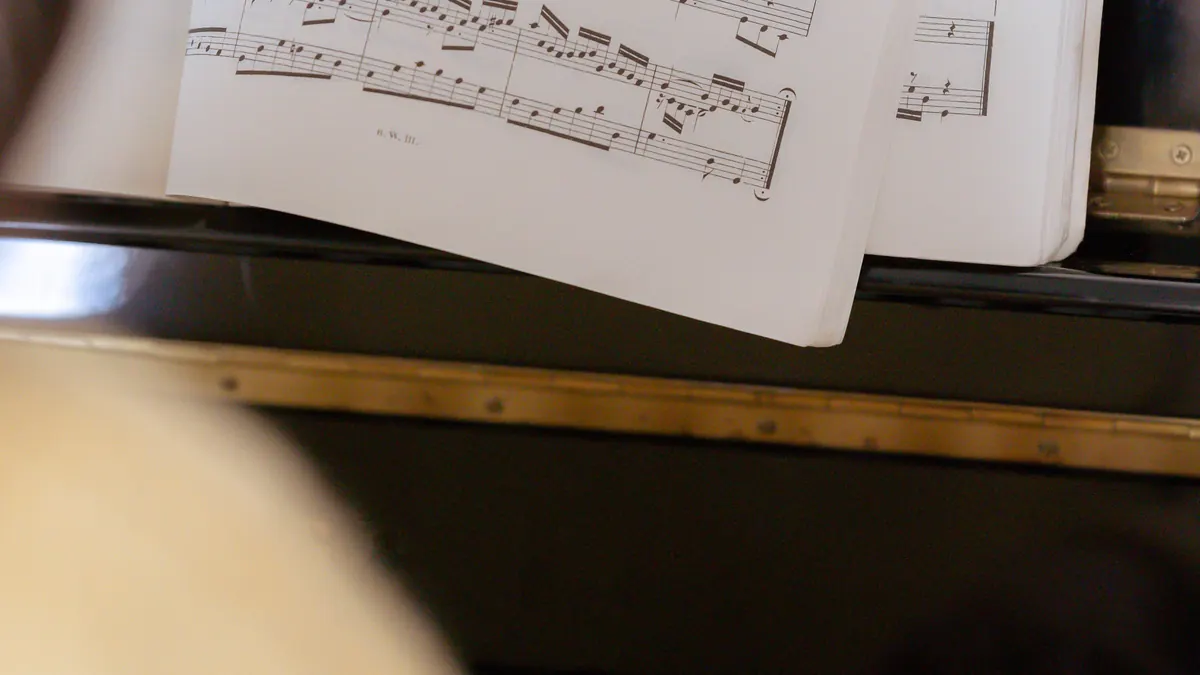
Sheet music can look like a secret code, but piano notation is built from a small number of simple ideas. Once you understand the staff, two clefs, a few landmark notes and how rhythm is written, you can read beginner music. Fluent reading takes regular practice, like reading a new language, but the basics can be learned in a week.
This guide explains everything step by step. Keep your piano or keyboard nearby and play each example as you read.
The staff
Music is written on a staff: five horizontal lines with four spaces between them. Each line and each space represents a white key. Notes higher on the staff are higher in pitch; notes lower on the staff are lower. Moving from a line to the next space up is one step up on the keyboard (C to D, for example).
When notes go above or below the staff, short extra lines called ledger lines are added.
The grand staff: two staves for two hands
Piano music uses two staves joined by a brace, called the grand staff. The top staff usually shows the right hand and higher notes; the bottom staff usually shows the left hand and lower notes.
- The top staff has a treble clef (the curly G clef). Its curl wraps around the second line from the bottom, marking that line as the G above middle C.
- The bottom staff has a bass clef (the F clef). Its two dots surround the second line from the top, marking that line as the F below middle C.
Treble clef notes
From bottom to top, the lines are E, G, B, D, F. A common memory phrase is "Every Good Boy Does Fine."
The spaces, from bottom to top, spell F, A, C, E: "FACE."
Bass clef notes
From bottom to top, the lines are G, B, D, F, A: "Good Boys Do Fine Always."
The spaces, from bottom to top, are A, C, E, G: "All Cows Eat Grass."
Middle C and landmark notes
Middle C sits on its own short ledger line between the two staves. In the treble clef it sits just below the staff; in the bass clef just above it. It is the same key on the piano.
Memory phrases are useful at first, but fluent readers use landmark notes and count from them. Learn these landmarks first:
- Middle C: the ledger line between the staves.
- Treble G: the line the treble clef curls around (second line from the bottom).
- Bass F: the line between the bass clef's dots (second line from the top).
- Treble C: the third space of the treble staff, an octave above middle C.
- Bass C: the second space of the bass staff, an octave below middle C.
To read any note, find the nearest landmark and count up or down by lines and spaces. With practice, you will recognize notes instantly.
Rhythm: how long each note lasts
The note's position tells you which key; its shape tells you how long to hold it. In the most common time signature, 4/4, the quarter note gets one beat.
- Whole note (hollow oval, no stem): 4 beats.
- Half note (hollow with a stem): 2 beats.
- Quarter note (filled with a stem): 1 beat.
- Eighth note (filled with a stem and a flag, or joined to others by a beam): half a beat. Count "1 and 2 and."
- Dotted note: a dot after a note adds half its value. A dotted half note lasts 3 beats.
Rests are silences with the same lengths: whole rest, half rest, quarter rest and eighth rest. Silence is part of the rhythm, so count rests just as carefully as notes.
Bars and time signatures
Vertical bar lines divide music into measures (bars). The time signature at the beginning tells you how many beats are in each bar and which note gets the beat.
- 4/4: four quarter-note beats per bar. Most pop music.
- 3/4: three beats per bar. Waltzes and songs like "Amazing Grace."
- 2/4: two beats per bar. Marches.
Sharps, flats and naturals
- A sharp (#) raises a note by one half step: play the very next key to the right (often a black key).
- A flat (b) lowers a note by one half step: the next key to the left.
- A natural cancels a sharp or flat.
An accidental written in front of a note applies to that note for the rest of the bar.
Key signatures
Sharps or flats placed right after the clef at the start of each line form the key signature. They apply to every matching note throughout the piece. For example, one sharp on the F line means every F is played as F sharp: that is the key of G major (or E minor). No sharps or flats means C major (or A minor), which is why beginner music starts there.
Other common markings
- Dynamics: p (piano) means soft, f (forte) means loud, mp and mf are medium soft and medium loud.
- Finger numbers above or below notes: 1 is the thumb, 5 the pinky.
- Tie: a curved line joining two identical notes. Play once and hold for both values.
- Slur: a curved line over different notes. Play them smoothly connected.
- Repeat signs: double bar lines with two dots. Go back and play the section again.
How to practice reading
- Five minutes a day of note drills, using flashcards or a free note-reading app.
- Read very easy music, below your playing level, every day. Reading improves with volume, not difficulty.
- Read intervals, not just letters. Notice whether the next note is a step (line to space) or a skip (line to line).
- Clap and count the rhythm first, then play the notes.
- Keep your eyes on the page. Find hand positions by feel, using the black keys as landmarks.
Summary
Piano sheet music uses the grand staff: treble clef for higher notes, bass clef for lower notes, with middle C between them. Learn the landmark notes and count from them, learn note values and rests, and understand time and key signatures. Read a little easy music every day and reading becomes fluent with time. If you prefer to start playing right away and read alongside, our free 7-day beginner piano plan starts with chords and patterns.
More beginner piano guides
A Beginner Piano Practice Routine That Actually Works (15, 30 or 45 Minutes)
Ready-made 15, 30 and 45 minute practice plans, plus techniques that make practice count.
Read the guide
How to Teach Yourself Piano at Home: A Complete Self-Study Plan
Set goals, choose your materials, plan your weeks and check your own technique.
Read the guide
Learn Piano for Beginners: A Realistic Roadmap for Your First 3 Months
What you need, how the keyboard is laid out, your first chords and a month-by-month plan.
Read the guide
How to Play Piano for Beginners: 8 First Lessons You Can Do at Home
Eight first lessons, from posture and finding C to playing both hands together.
Read the guide